A Roundhouse is Not a Gazebo: Awkward Moments in Radical Real Estate Law
Workers from the Sustainable Economies Law Center share some memorable moments with clients that have transformed how they approach radical real estate law.


The adoption of fossil fuels to power the world economy has depended upon a fossil law that arranges a particular type of market and enforces a particular balance of power. One understudied, but central, aspect of this process is the use of state and corporate violence to compel the extraction and consumption of oil, gas, and coal.
In the housing context, a law to facilitate countervailing power must be geared toward encouraging tenant participation at the grassroots, building-by-building level, and it must be sufficiently robust so as to check the enormous power of corporate, financialized real estate.
we argue that to decommodify urban property, we need to fight not only for policy and funding which transfers land and housing to social ownership, but also for policies that make extractive and predatory housing models less viable and organizing more feasible. We need a strategy that incorporates both social housing and housing justice.
Creative and strategic militancies interrupt the normal functioning of society, shift the terms of debate in public discourse, and expand the definition of the common good. Never has this been more evident than when the Young Lords barricaded themselves inside The First Spanish United Methodist Church in East Harlem.
By inviting their members to learn bureaucracies and hold them accountable, the Gray Panthers empowered elderly people to see themselves as experts capable of disentangling convoluted bureaucracies and reshaping them to better address local needs.
By organizing and running free health centers, the Black Panthers not only delivered much needed social provisions. They also empowered participants to envision and pragmatically move toward new political horizons.
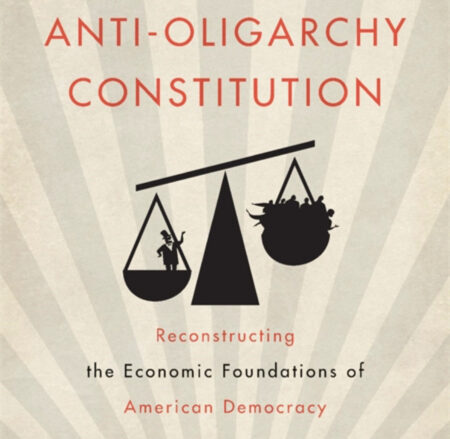
In the introduction to a symposium on their new book, The Anti-Oligarchy Constitution, Joseph Fishkin and William E. Forbath make the case for reviving interest among progressives in constitutional political economy.
In the second part of their conversation on LPE & disability, Rabia Belt, Doron Dorfman, Jasmine Harris, Jamelia Morgan, and Karen Tani discuss what LPE could gain from paying greater attention to disability, and where scholars interested in the nexus of disability and LPE should turn for additional resources.
In part one of their conversation on LPE & disability, Rabia Belt, Doron Dorfman, Jasmine Harris, Jamelia Morgan, and Karen Tani discuss why disability has not been a more prominent theme in the LPE movement.
This essay examines LAPD’s use of “reform” strategies to co-opt criticism and expand data-driven policing, with a focus on the role of lawyers and legal academics.
Gerald Torres reflects on the ideas that animated the life of Lani Guinier.
What role do lawyers play in advancing progressive social change? Examining the recent history of labor activism in Los Angeles, Scott Cummings distills some lessons for legal mobilization in contemporary social movements.
In the wake of a historic victory by India’s farmers, Veena Dubal and Navyug Gill reconvene to discuss the events that have unfolded over the past year, how to understand Modi’s capitulation, and what lessons other social movements can draw from this victory.
In the United States, the rule of law has always had property rights as its lodestar, with private property serving as the central legal interest that requires protection. Attending to our history reveals the dangers and paradoxical nature of this property-first conception of the rule of law.