Skip to content
LPE Originals

Under the Guise of Care

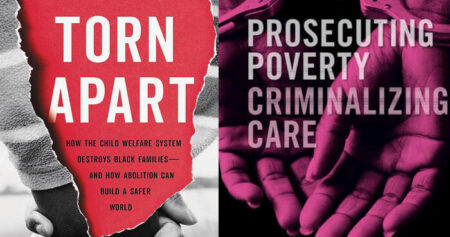
The carceral state is in a deep legitimacy crisis, with questions about its proper function up for public debate, and social movements pushing for care, public safety, and accountability. Municipalities, meanwhile, are experimenting with non-police responses to varied social problems. These efforts are important: they signal that abolitionist organizing and social insurgency have built sufficient power that the political elite has had to respond. But as Dorothy Roberts and Wendy Bach teach us, care often provides cover for criminalization, and the deployment of professional services often works hand in glove with systems of punishment.


LPE Originals

Building a World Without Criminalized Care

In 2013, a group of Tennessee legislators made it a crime for a pregnant woman to transmit narcotics to a fetus. The law’s supporters offered many of the traditional justifications for criminal law, but they also leaned heavily on a less familiar argument: that creating this crime would, in effect, create care. Indeed, they argued that criminalizing this behavior was a logical response to Tennessee’s opiate epidemic and healthcare crisis, as it would create incentives for judges to draw more treatment resources into court. However, to the extent that the women prosecuted under this law received any care from our legal and social welfare systems, that care was corrupted by its location within or near punishment systems.

LPE Originals

Building a World Without Family Policing

Far from promoting the well-being of children, the so-called child welfare system weaponizes children as a way to threaten families, to scapegoat parents for societal harms to their children, and to buttress the racist, patriarchal, and capitalist status quo. Torn Apart tears off the benevolent veneer of family policing to reveal its political reality and argues that it must be abolished. To achieve this end, we need a paradigm shift in the state’s relationship to families — a reimagining of the very meaning of child welfare.

LPE Originals

Toward Prefigurative Lawyering

Our current moment, filled with peril for all but those with extreme wealth, is one that calls for radical experimentation with utopian institutional and social forms – what are sometimes referred to as “prefigurative” projects. Yet legal education and dominant legal practices tend to constrain the imaginative capacities necessary for such projects. To overcome these constraints, lawyers and law students must learn to engage in shared social analysis with movement partners.

LPE Originals

A Wagner Act for Tenant Unions

One often overlooked reason for the current rental housing crisis is the imbalance in bargaining power between landlords and tenants. To address this imbalance, Duncan Kennedy, Karl Klare, and Michael Turk argue that we must empower tenant organizing and sketch the architecture of a legislative package that would entitle tenants to organize into unions with specified rights, powers, and protections against retaliation.

LPE Originals

From Work in Prison to Carcerality at Work

How might organized labor be engaged in ending mass incarceration? One approach is to emphasize how carceral labor is exploited as a substitute for rights-bearing “free labor.” But the mere threat of substitution does not ensure solidarity. A more promising avenue is to consider how carcerality itself extends into so-called “free” labor markets. Under this “carceral labor continuum,” anti-carceral unionism emerges not from broad concerns over economic substitution but instead from the practical demands of workplace organizing.

LPE Originals

Strategic Lessons from Abolitionist Labor Struggle In Immigration Detention

Since last summer, immigrants detained in California’s Mesa Verde and Golden State Annex detention centers have been on strike, demanding fair treatment as workers. Meanwhile, legal advocates have engaged in strategic policy campaigns and wage-and-hour litigation to support the strike from the outside. This partnership offers a valuable model for how solidarity and empowerment can blaze a path toward abolition.

LPE Originals

Not Worker, But Chattel

In this essay, the author draws on his experiences as an incarcerated organizer to argue for the importance of a Black abolitionist politic that resists both “work” and the adoption of the “worker” identity. Instead, the category of the slave-in-revolt is better suited to the project of abolitionist organizing.

LPE Originals

Defendants, United, Could Strike the State Blindsided

The American penal system is astonishingly vulnerable to the threat of defendant collective action. The reason is simple: the system is massively overleveraged. Major city court systems, which only have the capacity to bring to trial about 3 percent of the cases they handle, are dependent on plea bargaining to remain minimally functional. If even a tiny percentage of defendants banded together and refused to plead guilty, they would bring the administration of criminal justice to a grinding halt. What might such a plea strike look like? And should such a tactic be attempted?

LPE Originals

How Free Trade Threatens Global Democracy

As we debate matters of near-shoring, friend-shoring, and globalization, we must not forget the lessons of the recent past: from Argentina to India, the pursuit of open economies involved a brutal crack down on labor union resistance. In the process, many governments unleashed dynamics that now threaten the survival of democracy itself. Hope, though, can be found in the recent strengthening of labor movements globally, as well as the potential to bolster unions through industrial policy and the transition to a green economy.

LPE Originals

What CLS Meant by the Indeterminacy Thesis

One the CLS movement’s most significant contributions was the theory of law’s inherent tendency towards indeterminacy. Yet, despite broad agreement about its importance, the thesis itself is frequently misunderstood. This confusion arises, in part, because CLS put forward two very different approaches to formulating the indeterminacy thesis. We can, however, unify these two approaches by regarding indeterminacy as a kind of collective experience that legal actors produce as part of their interpretative work, and fight for as part of their shared political projects.

LPE Originals

Rural Civil Disobedience and Fossil Capital: Toward Radical Futures

Civil disobedience has long been a core dimension in the struggles against the ravages of the coal, oil, and natural gas industries in the rural United States. While Indigenous-led resistance to the Dakota Access Pipeline is the most prominent recent example, the past decade has witnessed acts of civil disobedience in such far-flung locations as the Montana coalfields, the Keystone XL Pipeline in Texas, and pipelines in Minnesota and Louisiana. How should we make sense of these actions? And what can these acts of rural resistance teach us about our understanding of civil disobedience?